
AI + Design Thinking: When Building Is No Longer the Hard Part
Why speed alone won’t build better products, and how AI + Design Thinking gives you direction, clarity, and validation.

Classic Processes Start to Feel Heavy
AI is reshaping how we build products. The tools, the speed, responsibilities, and the skills we need are changing. Now building takes minutes. Anyone with an idea and a laptop can build something real by the end of the day. It feels like a superpower. And it is!
The processes we relied on feel like they were designed for a different world: multi-week discovery workshops, development sprints with meetings after meetings and 10 types of ceremonies.
But here’s what hasn’t changed: understanding people, finding the right problem, and validating what you build. That was always what separated products that work from products that don’t.
And let’s be real, even before AI, many teams skipped this research and understanding part. Building was expensive, so that’s where all the energy went. Smaller teams put everything into development. And even when you knew you should spend more time on the problem, there was always this fear of losing momentum.
Now that fear is louder than ever. Building is so fast and so exciting that everything else feels like it’s slowing you down.
The old processes don’t fit the new reality. Simply using new tools is not enough. We need new ways of working that keep the important parts in without slowing us down.
Why AI + Design Thinking?
Here’s the current reality: you have an idea for helping freelancers manage invoices. You open Lovable, prompt your way to a dashboard, add some features that seem useful, and ship it. It looks great. It works. But nobody cares. You spent a week iterating on something nobody asked for.
This happens all the time. The tools make it so easy to build that skipping the groundwork doesn't feel like skipping. It feels like progress.
I’ve spent over 15 years in design and product, and during the last 10, I've been hands-on prototyping or facilitating in design sprints, problem framing, and innovation workshops for companies like SAP, Experian, LLoyds, Vorwerk, and Dun & Bradstreet.
When AI changed how we design and build, I started asking myself:
How do we adapt? What do we need now that building is no longer the bottleneck?
I looked at the methods I’d been using for years and thought about the parts that are still valuable, the things that need to change, and where can AI amplify the process.
What I found is that AI + Design Thinking can be a really powerful combination.
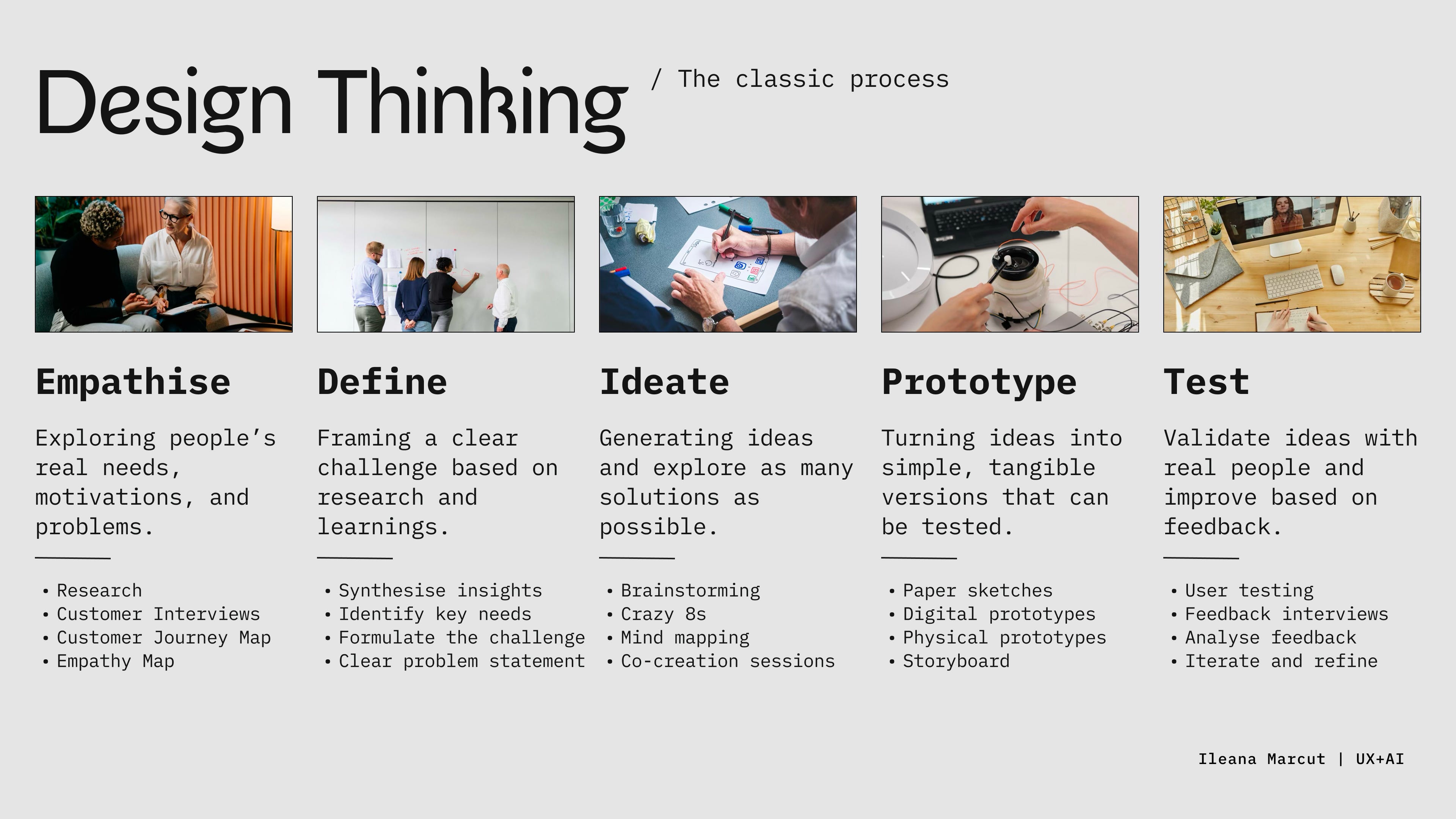
Design Thinking: Short Definition
At its core, Design Thinking is about understanding people first, getting clarity, and making sure that what you build actually makes sense in the real world.
Design Thinking is a methodology and a mindset that helps you solve problems and build solutions that meet real human needs.
It helps you define real problems, explore solutions, and test before you put all the energy and resources. It’s been used for decades across industries, from product design to business strategy to social innovation.
The classic process has 5 core stages:
Empathize: understand the people you’re designing for.
Define: frame the real problem worth solving
Ideate: explore possible solutions
Prototype: turn ideas into something tangible and testable
Test: put it in front of real people and learn
These stages aren’t strictly linear. You move back and forth between them as you learn. And the methods you use within each stage aren't fixed either. You pick what works for your project, your team, and your constraints.
AI + Design Thinking: Why This Works
I know many people push back on processes.
They feel rigid. They slow you down. And if you follow them blindly, they can.
But that’s not how these methods are meant to work. Design Thinking was always meant to be flexible, adapted to your project, your team, your constraints. The real value isn’t in the steps. It’s in the mindset behind them: knowing which method works for your challenge, how to combine them, and how to create the right approach to get the results you need.
The value isn't the AI tools alone, it's having the right approach, and knowing where and how to use AI and these methods so you can build your own process.
The principles are there. The methods are there. The AI capabilities are there. The real skill is knowing how to combine and balance them to fit your goal, your team, and whatever you’re trying to achieve.
You can use Design Thinking methods to get started, to research, to validate, to build, to learn, to pivot, and to grow.
AI + Design Thinking = Speed + Direction
AI lets you do things that weren't realistic before: process large amounts of data, find patterns, and go from concept to a working product in hours. Work that used to take entire teams and weeks.
But you can't or should do everything with AI. AI doesn’t know if you’re solving the right problem, it doesn’t understand who your user is, or deep emotions and cultural nuances.
Design Thinking gives you that direction.
It keeps you grounded in reality: real problems, real people, and real validation.
It's simple:
AI gives you speed, and new capabilities. Design Thinking gives you structure, clarity, intention, while keeping people at the centre.
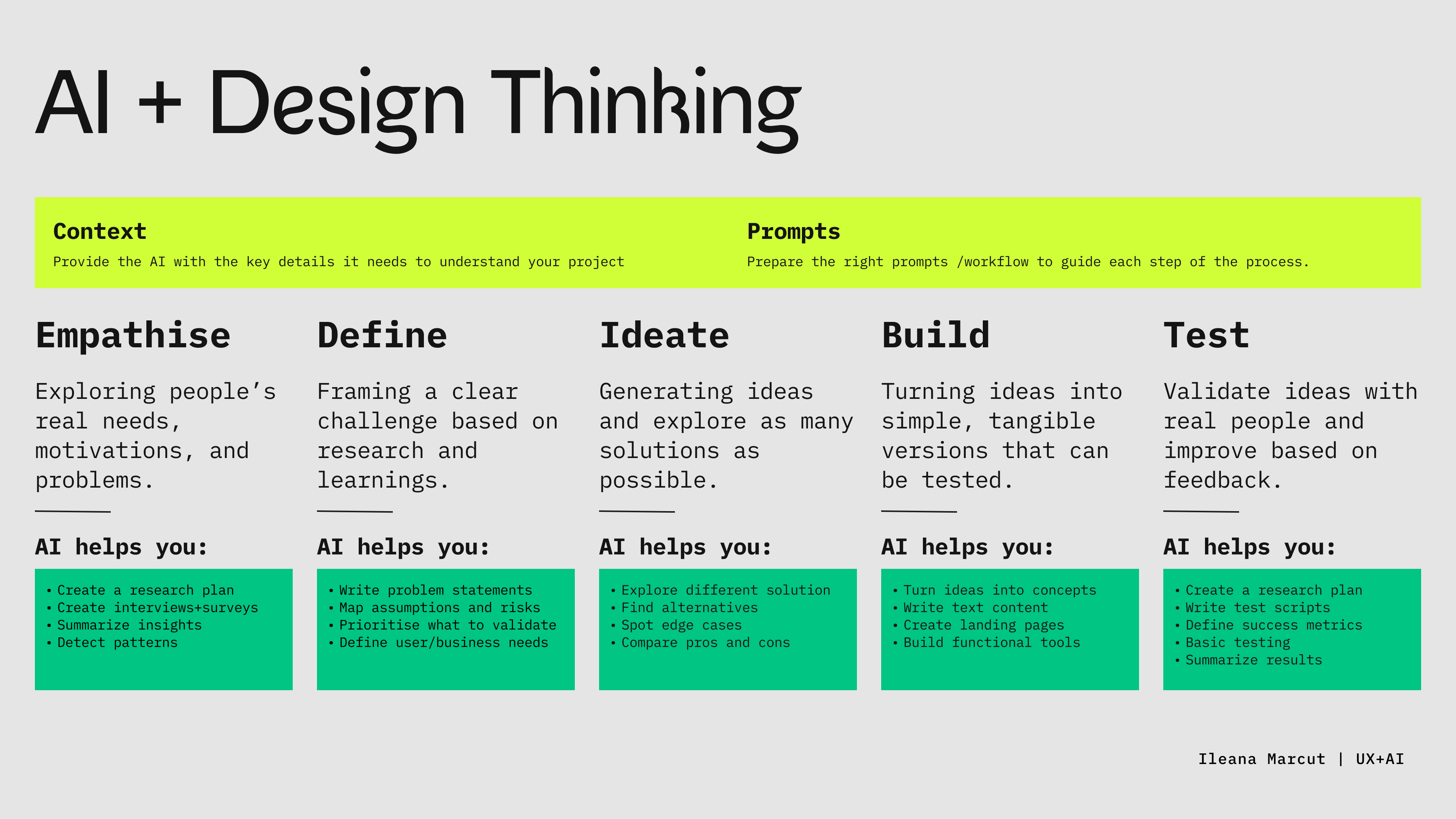
How the Process Changes with AI
We keep the core stages: Empathise, Define, Ideate, Build, Test.
Prototype becomes Build because you can now make real, functional things.
But the level of build complexity, this is all up to you, and what you want to achieve.
AI can now support you in every stage. Here are some examples:
Empathise: create research plans, draft interviews, summarize insights, detect patterns.
Define: write problem statements, map assumptions and risks, prioritise what to validate.
Ideate: explore different directions, find alternatives, spot edge cases, compare pros and cons.
Build: go from concept to a working product in hours, a real, functional thing people can use.
Test: write test scripts, define success metrics, summarize results.
The real difference isn’t where you use AI.
It’s how you approach it.
Use AI where it adds real value: processing data, finding patterns, exploring directions, building fast. Don’t use it just because you can.
Keep the human steps where they’re imperative: talking to real people, understanding emotions and context, making judgment calls, deciding what matters.
Prepare to get the best outcomes: document your context, structure your prompts, brief AI like you’d brief a collaborator. The better the input, the better the output. This preparation layer (your context and your prompts) sits on top of the entire process. It’s what makes AI actually useful instead of random.
Collaborate with your team and partners: align on context before anyone starts prompting. Decide who does what. Bring different perspectives into the process.
Use AI to challenge, not just to create: let it push your thinking, surface edge cases, question your assumptions. Not just build what you asked for, but help you ask better questions.
The Part We Skip Is the Part That Matters
It’s tempting to jump straight to building. The tools make it easy.
And the thinking, the research, the problem framing, the validation, and the work you need to do after the launch, it all feels like it’s slowing you down.
But that’s the part that determines whether what you build works and if anyone needs it.
AI gave us the power to build anything. Knowing what to build, who to build it for, and how to differentiate from the competition, that matters more now than ever.
Frameworks like AI + Design Thinking, exist to make sure you don't just move fast, but with intention and in the right direction.
Thanks for reading 🫶

Hot News 🔥
I'll be running the "From Idea to Validation” workshop also online.
And, if you subscribe to UX+AI with the yearly plan you can join for FREE.
In this workshop, you’ll bring an idea, work on it using Design Thinking methods powered by AI, and leave with something tangible created during the session.
⭐️ More about the workshop here!
More UX + AI Reads 👇🏽


Let’s Collaborate 💫
Open to Substack collaborations. I’m one DM away!
I design and build digital products + AI solutions. Let’s chat!
1:1 AI + Design deep dives for creatives, designers, and product people. Book here!
This lines up with something I've been thinking about a lot. I can ship a working app in a day now but that doesn't mean anyone will use it.
The speed makes it easier to skip the hard questions, who needs this, why, and how do I know I'm right?
I've built things I was the target user for, and validation happened naturally because I felt the pain. But for anything else the temptation to just build is so strong.
Love this perspective. AI accelerates output, but real value still comes from understanding people, framing the right problems, and validating solutions.